It’s a January morning in Sudbury, the thermostat hasn’t caught up yet, and you’ve just stepped barefoot onto the kitchen floor. That one cold shock is where a lot of tile conversations start. A few weeks later the same homeowner is standing in a showroom holding three samples that all look fine, wondering why one costs half as much as the next and whether it actually matters.
It matters, but not always in the way the price tags suggest. Tile flooring in Sudbury, MA has to deal with real winters, wet boots, salt, old framing and a lot of houses that were built long before anyone thought about 24-inch tiles. The material you pick is only half the story. The other half is what’s underneath it and who sets it.
So here’s a plain-spoken walk through porcelain, ceramic and natural stone, written for homeowners in Sudbury, Acton, Waltham, Billerica and the towns around them. We’ll cover what each material does well, where it lets you down, and what makes a tile installation in Sudbury, MA last twenty years instead of two.
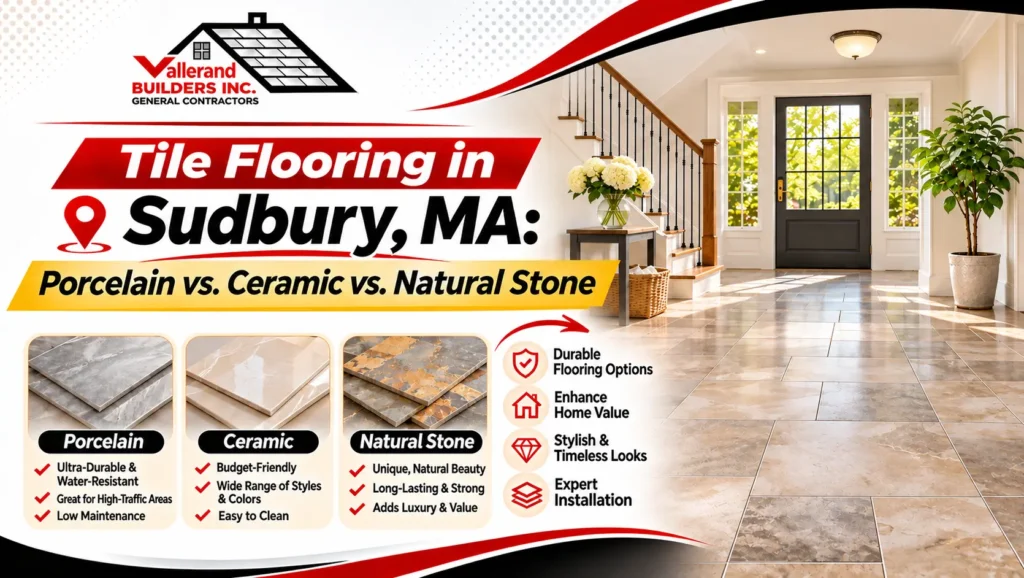
Porcelain, ceramic and natural stone: what you're really choosing between
Most people think of this as a style choice. Partly it is. But these three families behave differently once they’re wet, cold, dropped on or scrubbed for a decade, and that’s worth knowing before you fall for a color.
Ceramic tile
Ceramic is the classic. It’s typically a bit softer and more absorbent than porcelain, which makes it easier to cut and usually easier on the budget. For a bathroom wall, a backsplash or a low-traffic floor, it’s a perfectly good answer. Honestly, for a guest bath that gets used by two people a day, you don’t need to spend more.
Where ceramic struggles is hard use. Heavy kitchen traffic, dropped cast iron, grit tracked in from the driveway. Glazed ceramic can chip, and when it does, the lighter body underneath shows through.
Porcelain tile
Porcelain is the workhorse. Industry standards define it as a tile with water absorption of 0.5 percent or less, which is the whole reason it’s so dense and so tolerant of moisture. The Tile Council of North America notes that some products get sold as porcelain without meeting that number, so if the label matters to you (say, for an entry or a basement), ask for the manufacturer’s spec sheet rather than trusting the sign on the shelf.
Porcelain handles wet boots, heavy appliances and kids. It comes in wood looks, stone looks, concrete looks and very large sizes. The trade-off is that it’s hard and dense, so it’s tougher to cut, a bit less forgiving to install, and unforgiving underfoot if you drop a glass.
Natural stone: marble, travertine, slate, limestone and granite
Stone is a different animal, and it’s worth being honest about that. Each one has its own personality.
Marble is beautiful and a little demanding. It tends to etch when acidic things like lemon juice or some cleaners sit on it. Travertine has a warm, soft look, with natural pits that are usually filled during manufacturing and may need attention over the years. Slate is rugged and textured, great for a mudroom, though the surface can be uneven. Limestone is softer and ages with character, or with wear, depending on your point of view. Granite is very hard, though it’s more often seen on countertops than as floor tile, and polished granite can be slick when wet.
Stone also varies from one piece to the next. That’s the charm, and it’s also why you want to see the actual tile (or a big sample run) before you commit. Natural stone tile flooring rewards owners who like a floor with a story and don’t mind a little upkeep.
Water, frost and Massachusetts winters
This is the part that generic tile articles skip. A floor in Sudbury doesn’t just face spills. It faces slush tracked in at 7 a.m., a mudroom that sits cold for weeks, and basements that pick up humidity every spring.
Moisture and absorption
The lower a tile’s absorption, the less water it takes on. That’s why porcelain is the usual pick for places that get wet regularly, and why ceramic is better kept to areas that mostly stay dry. It’s not that ceramic fails the moment it’s damp. It’s that low-absorption tile gives you more margin for error.
Keep in mind that tile itself isn’t what keeps water out of a house. Grout isn’t waterproof, and tile isn’t a membrane. In wet rooms, the waterproofing layer beneath the tile does the heavy lifting, and we’ll come back to that when we get to bathrooms.
Mudrooms and entries
A mudroom that stays unheated through winter is a freeze-and-thaw machine. Water gets into any porous material, freezes, expands, and over a few seasons you get cracks or flaking. If the space is truly unheated or open to the outdoors, ask for a tile the manufacturer specifically rates for that exposure, and don’t assume an interior tile will cope.
Most mudrooms in Acton or Billerica are enclosed and at least somewhat heated, which is much kinder. Even so, porcelain is the safer bet here, preferably with some texture. Polished tile and melting snow don’t get along.
Heated tile floors
Heated tile floors are one of the most common requests we hear from Massachusetts homeowners, and it’s easy to see why. Tile feels cold because it’s dense and pulls warmth from your feet. Put gentle heat under it and the same density holds that warmth and spreads it nicely.
Electric cable or mat systems are the usual choice in a remodel, and they’re a natural fit for a bathroom or a kitchen. Both porcelain and ceramic work well over them. Many natural stones do too, though thicker or more delicate stone may have its own rules, so the heating manufacturer’s guidance and the stone supplier’s guidance both need to agree before anything gets bought.
One thing worth planning early: the heating layer adds height, and it needs to be coordinated with doorways, adjacent floors and thermostats. It’s easier to design that in than to chase it afterward.
Slip resistance, grout and everyday upkeep
Slip resistance
A pretty tile that’s treacherous when wet is a bad tile for a bathroom. The industry measures this with a wet dynamic coefficient of friction, or DCOF. Under the current ANSI A326.3 standard, tile intended for level interior areas that get walked on wet is expected to reach 0.42 or higher, or the manufacturer declares it suitable for that use. Per the Tile Council of North America, though, that number is a comparison tool, not a promise that nobody will slip.
In plain terms, check the spec, favor a bit of texture where water is likely, and remember that a very large, glossy tile in a wet entry is rarely the right call. Small mosaic tiles in a shower floor help because there’s more grout line to grip.
Grout choices
Grout is where good floors go to look tired. Light grout in a kitchen picks up everything. Very dark grout can show every white haze and mineral deposit. A mid-tone that sits close to the tile color is forgiving, and honestly it’s what we’d suggest to most busy households.
Cementitious grout is the traditional route and comes in a huge range of colors, but it needs to be kept clean and, in many cases, sealed. Epoxy grout resists stains better, though it can be less forgiving to work with and costs more. Wider joints mean more grout to maintain. Narrow joints look sleek, but they demand a very flat floor and a skilled hand.
Sealing stone
Stone is porous, and sealing is how you slow down staining. A good sealer doesn’t make marble or limestone stain-proof. It buys you time to wipe up the wine. Plan to reseal periodically, and ask your installer or the stone supplier how often that’s likely for your particular stone and traffic.
The part under the tile: prep in older homes
Here’s the unglamorous truth. Most tile failures aren’t about the tile. They’re about movement underneath. A beautiful floor on a flexy subfloor will crack grout first, then tile, usually in a pattern that makes the cause obvious.
Subfloor and deflection
Homes in Sudbury, Waltham and Billerica run from newer builds to well-worn capes and colonials with original framing. Older floors can bounce a little. Tile and especially stone don’t like that, because they’re rigid and the floor underneath isn’t.
Before any tile goes down, someone competent should check the framing, the subfloor material and its condition. Sometimes that means adding a layer of plywood. Sometimes it means stiffening the joists. Sometimes it means a cement backer board, and in other cases an uncoupling membrane that lets the tile and the subfloor move a little independently. Which one fits depends on what’s actually there, and a decent contractor will tell you why they’re picking it.
If the floor is soft near a bathtub or the sink cabinet, mention it. Old leaks leave rot behind, and tiling over that is expensive regret.
Flatness and large-format tile
Large tiles are popular for good reasons. Fewer grout lines, a calmer look, a bigger-room feel. But they’re also fussy. The Ceramic Tile Foundation, citing ANSI A108.02, states that for tiles with at least one edge 15 inches or longer, the substrate needs to be flat to within 1/8 inch over 10 feet, and the Ceramic Tile Foundation also warns against using thin-set to fill low spots.
Most older floors don’t start out that flat. So expect some patching, grinding or self-leveling before large tile goes down. If a quote for large-format tile doesn’t mention floor prep at all, that’s a question to ask.
Layout, transitions and installation sequence
Layout and pattern
A good layout starts with where your eye lands when you walk in. Most installers will dry-lay the pattern and find the center lines of the room, so you don’t end up with a tiny sliver of tile along the most visible wall. A running bond, a herringbone or a plain stacked grid each says something different, and each wastes a different amount of material.
Diagonal and herringbone layouts look great and take longer to cut and set. Plan on more labor and a bit more waste than a straight lay.
Transitions
Tile rarely meets only tile. Somewhere it meets hardwood, carpet or vinyl, and that edge needs a plan. Floors that start at different heights are easy to fix on paper and annoying to fix later. A thin threshold, a flush reducer or a slight sloped transition will all work. Decide before the tile is bought, because the thickness of tile, mortar and any underlayment all add up.
Sequence with cabinets and vanities
This one starts arguments. Should tile go under the cabinets or stop at the toe-kick? In a kitchen, the common answer is to tile where the floor will be seen and leave cabinet footprints alone, since you don’t want to pay for tile nobody sees and you don’t want to raise the floor under the cabinets. Vanities in bathrooms can go either way. Setting the vanity after the tile is common, but it means that any future vanity change is limited by what’s on the floor.
If you’re doing a kitchen remodel or a bathroom remodel at the same time, the order of work matters. Plumbing and cabinets, then tile, then final trim is a typical flow, and the schedule in our bathroom renovation timeline guide is a useful companion if the bath is part of the job.
Tile also has a temperature requirement. Mapei’s technical guidance says most industry specifications recommend setting tile between 50°F and 95°F, with the substrate and surrounding air kept at 50°F or warmer during installation and for at least seven days afterward (or 72 hours with rapid-setting products). Per Mapei’s cold weather tile tips, that’s why a heated house in January is a perfectly fine place to tile, and a cold, unheated addition isn’t.
Room-by-room advice
Kitchen tile flooring
Kitchen tile flooring takes a beating. Dropped pans, spilled sauce, a dishwasher that leaks once. Porcelain is the sensible default for most households. Choose a surface with a little grip, a grout color that forgives, and think about how comfortable it is to stand on for an hour while cooking. Tile is hard. A good rug or anti-fatigue mat in front of the sink is an honest fix.
If you’re also changing cabinets, our guide on what to consider when remodeling a kitchen covers the other decisions that touch the floor.
Bathroom tile flooring in Massachusetts
Bathroom tile flooring in Massachusetts is where moisture management really counts. Porcelain or well-chosen ceramic works. A textured or small-format tile near the shower is safer. Under the tile, a proper waterproofing system in the shower area matters more than the tile itself, because the tile’s job is to look good and the membrane’s job is to keep water out of your walls.
Heated floors earn their keep here more than anywhere. If you’ve ever stepped out of a winter shower onto cold tile, you already know.
Mudroom and laundry
Both are wet-boot, wet-basket, wet-dog rooms. Choose a textured porcelain or slate if you like that look. Plan a slight drain-friendly layout in the laundry if there’s a risk of a washer overflow, and think about extending the tile a little past the door so melting snow doesn’t land on a wood floor.
Basements
Basements need caution. Concrete slabs can carry moisture, and moisture and tile adhesives don’t always get along. Before tiling a basement, find out whether the slab is dry, whether there’s any history of dampness, and whether you need a moisture-mitigating system underneath. Porcelain handles damp better than most, but it doesn’t solve a wet slab. If the basement floods occasionally, that’s a bigger conversation than tile.
What cost really depends on
We’re not going to throw dollar figures at you, because they’d be wrong by the time you read them. What we can say is where the money tends to go.
Tile itself is rarely the biggest line. Prep, labor and complexity usually are. A plain ceramic in a straight lay over a sound floor is the budget end. Large-format porcelain over an older floor that needs leveling, or herringbone stone with a heated system underneath, sits much higher, mostly because of the work, not the material.
Stone typically costs more to buy and more to maintain than porcelain. Porcelain that imitates stone often gives you most of the look with less upkeep, and for most families that’s the smart trade. If you love real stone, though, there’s no substitute, and that’s a fair reason to spend.
Mistakes that sink tile jobs
A few patterns show up again and again.
- Picking tile first and thinking about the floor later. The tile you love might need a flatter floor than the one you have.
- Skipping waterproofing in wet areas because “tile is waterproof.” It isn’t, and grout lines are not either.
- Choosing a glossy tile for a wet room because it looked nice in the store.
- Underestimating how much prep an older home needs.
- Letting price alone choose the installer.
- Forgetting transitions and door clearances until the floor is down.
None of these are exotic. They’re just decisions that get made too late.
Choosing a tile contractor in Sudbury
If you’re looking for a tile contractor in Sudbury, Acton, Waltham or Billerica, skill matters more than a slick brochure. A great tile setter is patient, a little obsessive about flatness and happy to explain choices. You can learn a lot from how someone answers a few simple questions.
Here’s what to ask:
- How will you check and prepare the subfloor, and what happens if you find a problem?
- What are you putting under the tile in the wet areas?
- How flat does the floor need to be for this tile, and how will you get it there?
- Are you licensed and insured, and can I see it?
- Who will actually be doing the work, and what does the schedule look like?
- How will you handle transitions and the cabinet or vanity sequence?
- What does the warranty cover, and what voids it?
You can see how we work on our flooring and tile page, read what other homeowners say on our testimonials page, or learn more about us. If you’re in the area, our Sudbury service page, Acton page and Waltham page explain what we do there. Tile is often one part of a bigger renovation or remodel, and it helps to have one team looking at the whole picture. For ideas on what’s popular right now, see our look at kitchen and bathroom remodel trends for 2026.
Plan your tile project in Sudbury, MA
If you’re weighing porcelain, ceramic or stone for a kitchen, bath, mudroom or whole floor, the easiest next step is a conversation about the actual room. Vallerand Builders is a licensed and insured general contractor in Billerica with more than 30 years of experience, and we’re happy to look at your floor, talk through the prep and help you pick something that suits the room and your budget.
Reach out through our contact page or call 978-670-5533.
Tile flooring Sudbury, MA: frequently asked questions
Is porcelain or ceramic tile better for a Sudbury kitchen?
For most kitchens, porcelain is the better pick because it’s denser, takes on less water and holds up to heavy use. Ceramic can work in a low-traffic kitchen or on a budget, as long as you’re comfortable with a little more chipping risk. If the kitchen is the busiest room in the house, porcelain usually earns its price.
Can I put heated floors under tile?
Yes, and it’s a popular choice in Massachusetts. Electric cable or mat systems work well under porcelain and ceramic, and many natural stones too, though stone can have special requirements. Plan the heating system, thermostat and floor height early so the doorways and adjacent floors still line up.
Is natural stone a good idea for a bathroom?
It can be, if you like the look and don’t mind upkeep. Stone needs sealing, some types etch or stain more easily, and polished surfaces get slippery when wet. Porcelain that looks like stone is often an easier path for a busy family bathroom.
Does tile crack in a cold mudroom?
It can, particularly if water gets into a porous tile and freezes. An enclosed, heated mudroom is much safer than an unheated porch. If the space gets truly cold, ask for tile the manufacturer rates for that exposure and make sure the installation is designed for it.
How flat does my floor need to be for large tile?
For tiles with an edge 15 inches or longer, industry guidance cited by the Ceramic Tile Foundation calls for the substrate to be within 1/8 inch over 10 feet. Many older floors need patching, grinding or leveling to get there. Ask any contractor how they plan to check and correct it.
Can tile be installed in winter?
Yes, as long as the house is heated. Setting materials generally need the substrate and air to stay at about 50°F or warmer during installation and for several days after. A warm kitchen in January is fine. An unheated addition is not.
Do I need to seal porcelain tile?
Usually not, since porcelain is so dense. The grout lines may still benefit from sealing, depending on the type. Natural stone almost always needs sealing, with a schedule that depends on the stone and how much use the floor gets.
How do I choose a tile contractor in Sudbury, MA?
Look for someone who talks about prep and flatness before they talk about tile. Ask about licensing, insurance, waterproofing, transitions and the schedule, and ask to see similar work or read homeowner reviews. A clear, written scope tells you a lot about how the job will go.